Virtual Tour vs. In-Person Showing: What Homebuyers Should Know
Virtual tours can help you understand a home's layout and narrow your search, while in-person showings reveal the details a screen cannot capture. Here’s why homebuyers can benefit from using both.
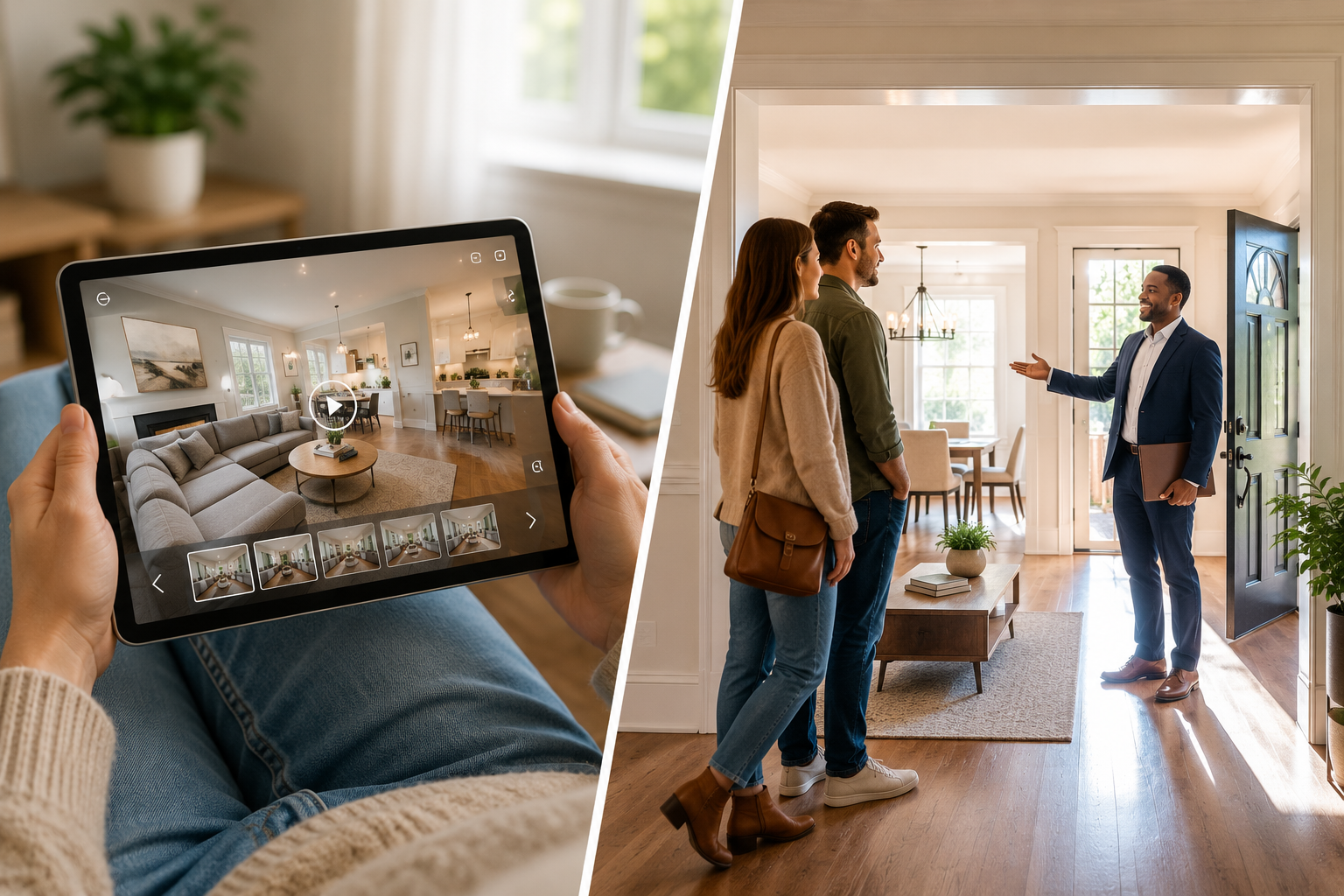
Searching for a home usually happens in two stages.
First, you narrow down the properties that look promising. Then, you spend more time evaluating the homes that make your shortlist.
Virtual tours have made that first stage much easier.
Instead of driving to every property that catches your attention, buyers can now explore layouts, walk through rooms digitally, and get a much stronger sense of a home before scheduling a showing.
But a virtual tour and an in-person showing are not the same thing.
Each gives you different information, and buyers can benefit from using both.
What Is a Virtual Tour?
A virtual tour allows you to explore a home remotely.
Depending on the listing, this may be a guided video walkthrough or an interactive 360-degree experience that lets you move between rooms and choose what you want to look at.
Unlike individual listing photos, a virtual tour can make it much easier to understand how the rooms connect.
You can see whether the kitchen opens into the living room, where the bedrooms are located, how hallways connect different areas, and whether the overall layout fits what you are looking for.
Some virtual tours are also paired with floor plans, which can provide an even clearer picture of how the home is arranged.
What Can a Virtual Tour Tell You?
One of the biggest advantages of a virtual tour is understanding the home's layout and flow.
Listing photos can make individual rooms look attractive, but they do not always show how those rooms relate to one another.
A virtual tour may help you discover that a bedroom is smaller than expected, the kitchen is separated from the main living area, or the primary bedroom is located farther from the other bedrooms than you would prefer.
These details can help you eliminate homes that clearly do not fit your needs before spending time on an in-person showing.
For buyers comparing several properties, that can make the home search much more efficient.
Virtual Tours Can Save Time
Scheduling showings can take time, especially when homes are located in different neighborhoods.
Virtual tours allow buyers to narrow their list before getting in the car.
Instead of touring every home that looks interesting in photos, you can use the virtual experience to identify the properties that deserve a closer look.
This can be particularly helpful for buyers with limited schedules or anyone relocating from another city or state.
What Does an In-Person Showing Tell You?
A virtual tour can show you what a home looks like.
An in-person showing tells you what it actually feels like to be there.
There are many details that a camera simply cannot capture.
You may notice traffic noise from a nearby road, sounds from neighboring properties, odors, squeaky flooring, worn finishes, or signs of moisture that were not noticeable online.
Natural light can also feel very different in person.
A room that appears bright in professional photography may feel darker depending on the time of day, window placement, or surrounding buildings and trees.
These sensory details can have a major impact on how comfortable you feel in the home.
You Can Evaluate Condition More Closely
An in-person showing also gives you the opportunity to look more carefully at the condition of the property.
Virtual tours are excellent for understanding layout, but they may not clearly reveal smaller maintenance issues.
When you visit the home, pay attention to flooring, walls, windows, doors, fixtures, ceilings, and other finishes.
Look for signs of wear, water damage, cracking, staining, or repairs that may need additional investigation.
A showing is not a substitute for a professional home inspection, but it can help you identify questions you may want answered before moving forward.
The Home May Feel Different Than It Looks Online
Size and scale can also be difficult to judge through a screen.
Wide-angle photography and camera positioning can make rooms appear larger than they feel in person.
Walking through the property allows you to understand whether furniture fits comfortably, hallways feel narrow, ceilings feel low, or rooms provide enough space for your lifestyle.
You can also experience how naturally you move through the floor plan.
Sometimes a layout that makes sense on a screen simply does not feel right once you are physically inside the home.
Don't Forget the Surroundings
An in-person visit is also your opportunity to experience everything outside the home's walls.
Step into the yard, patio, balcony, or driveway.
Pay attention to neighboring properties, street traffic, nearby businesses, parking, outdoor noise, and what you can see from the windows.
These factors can strongly influence your everyday experience of living in the home, but they may not be obvious from a virtual tour.
When Should You Schedule an In-Person Showing?
You do not necessarily need to visit every property you discover online.
Use virtual tours to create a shortlist first.
Once a property meets your basic requirements for location, price, layout, size, and features, schedule an in-person showing.
If you are seriously considering making an offer, seeing the home in person can be particularly valuable.
Use that visit to focus on the things you could not evaluate online rather than simply walking through the layout again.
Virtual Tours Are Especially Helpful for Relocation Buyers
If you are moving from another city or state, visiting every potential home may not be practical.
Virtual tours can help you narrow down your options before traveling.
You may also be able to ask your real estate agent to conduct a live video walkthrough so you can ask questions and request closer views of specific areas.
For some buyers, purchasing without personally visiting the property may be necessary.
If that happens, it is important to understand the limitations of relying entirely on digital information and to have trusted professionals evaluate the property carefully.
Use Virtual Tours and Showings Together
The strongest home-search strategy is not choosing between virtual tours and in-person showings.
It is using each one for what it does best.
A virtual tour helps answer:
Does this home's layout and general design work for me?
An in-person showing helps answer:
Can I actually imagine myself living here?
Using the virtual tour first means you can arrive at the showing already familiar with the property.
That allows you to spend your time evaluating the details that only an in-person visit can reveal.
The Bottom Line
Virtual tours have made house hunting faster and more efficient.
They can help you understand floor plans, compare properties, and eliminate homes that clearly do not meet your needs without scheduling unnecessary showings.
But they cannot replace the experience of physically walking through a property.
Noise, odors, natural light, room proportions, finishes, surrounding properties, and the overall feeling of the home are much easier to evaluate in person.
For most buyers, the best approach is to use virtual tours to narrow the search and in-person showings to evaluate the finalists.
Together, the two can help you make a more informed and confident decision about which home is right for you.
Source: Adapted from Redfin’s “Virtual Tour vs. In-Person Showing: What Homebuyers Should Know,” by Freda Nkrumah, published August 26, 2026.
This article is for general informational purposes only. Property condition, neighborhood factors, listing accuracy, and buyer needs vary. Buyers should independently evaluate homes and consult qualified real estate and inspection professionals before making purchasing decisions.